
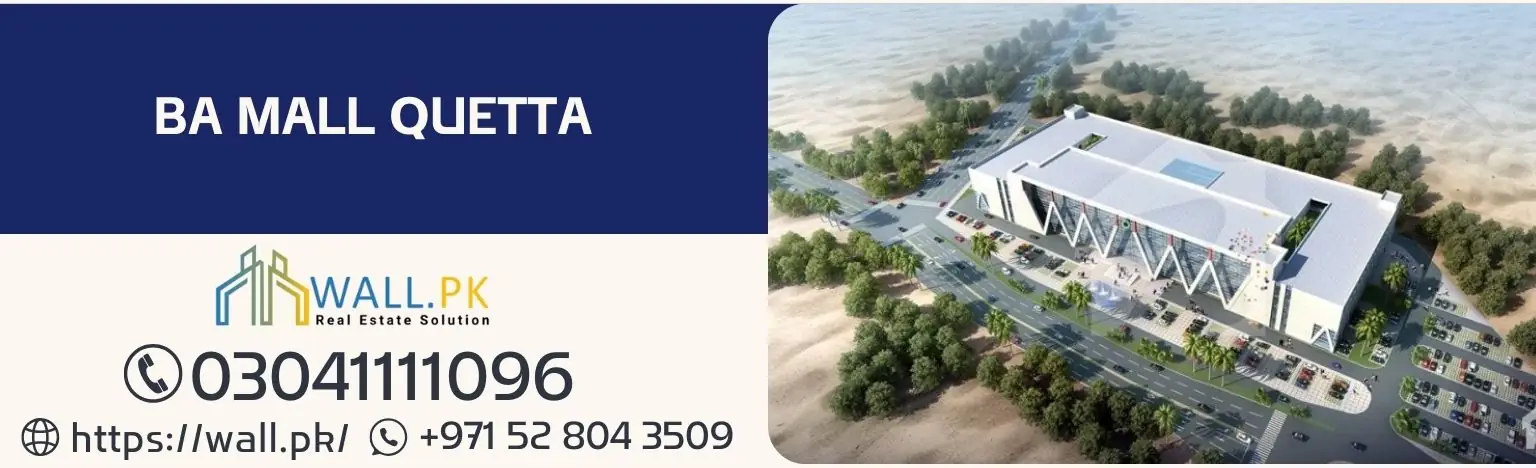
Situated in Quetta, BA Mall, or Balochistan Askari Mall, takes the crown for the first purpose built “modern era malls” in the region, ideally located in Quetta Cantonment.
Quick answers
BA Mall is being built by Green Land Developers. It is described as the Quetta region's first modern-era mall.
It is described as a mall for shopping, dining and relaxing in one place.
Located in the heart of Quetta, BA Mall is Quetta’s most central and accessible commercial hub on Ziarat Road in Quetta Cantonment and Askari Park, providing the best services to residents and out of towners alike.
The location is optimal because it is right next to Askari Park, one of the most popular destinations in Quetta, allowing the mall to tap in to the high visitor and revenue potential. This is one of the many reasons why people visit the commercial hub.
BA Mall is planned as Quetta's first purpose-built shopping mall, bringing together both international and local retail brands under one roof.
The complex is laid out across three floors and a basement. Corporate offices and showrooms occupy the lower ground level, while retail, fashion, and lifestyle stores for the public are spread across the upper floors.
Beyond shopping, visiting families can take in the mall's dining and entertainment spaces as part of a single visit.
Climate-controlled interiors are planned throughout the complex, aimed at keeping the mall comfortable for shoppers during Quetta's hot summers and cold winters alike.
Payment plan details and booking procedures are not available. The mall is described as Balochistan's first.
Researching this project?
Our research desk can confirm current status, pricing and availability, no commissions.
WhatsApp the research desk: +971 52 804 3509The local market context
Smaller-city schemes live and die on two factors: a genuine local demand anchor (an employer, a cantonment, a trade corridor) and credible paper with the relevant district authorities.
Where both exist, entry pricing well below the metros can compound quietly for years; where either is missing, low prices are usually fair prices. Benchmark the scheme against its corridor's delivered alternatives, weigh the commute math honestly, and let the authority's record, not the brochure, settle the approval question.
How buying a shop or showroom unit here actually works
Commercial unit purchases in a mall like BA Mall Quetta run on a different rail than residential plot files. For under-construction units, you are buying against the builder's schedule: a booking amount, milestone or monthly installments through the construction period, and typically a finishing payment plus a possession payment at handover.
For completed resale units, the sequence mirrors a plot deal, token, verification, written agreement, transfer, but the verification targets different paper: the unit's allotment and the builder's transfer record rather than a society plot ledger.
Whether new or resale, get the monthly service-charge and common-area maintenance schedule in writing before committing. It is the permanent cost of owning space inside a mall and varies widely between projects.
What you'll actually pay
For BA Mall Quetta, price four layers. The unit: the negotiated price or remaining installment schedule. Closing costs: builder transfer fee, documentation, taxes withheld at transfer.
Connection costs: electricity, gas and water meters where not included. Running costs: the monthly service charge. Ask for the rate, what it covers, and whether the building runs a sinking fund for lifts and structure. The last layer is the one buyers skip and residents regret.
Put every number in writing from the builder's office, schedule, charges, fees, and reconcile the seller's claimed payments against the office ledger before any agreement.
Documents that matter for a unit purchase
- Allotment / booking letter for the specific unit (number, floor, size) in the seller's name.
- Builder's payment ledger: paid installments, surcharges, and the remaining schedule.
- Approved building plan and the project's approval/NOC documentation for the land and construction.
- Completion / occupancy documentation where issued, for delivered buildings.
- Transfer letter issued by the builder's office at closing: the operative ownership document.
- Service-charge statement showing the unit is current.
- CNIC/NICOP copies of all parties, with attested POA for anyone overseas.
The builder's office record is the spine of apartment title. Verify every claimed document against it in person.
The right buyer profile
Match the asset to your situation. BA Mall Quetta rewards buyers with a multi-year horizon, comfort with the standard verification workload, and either an end-use plan or the patience to let the corridor mature.
If your priorities are instant resale liquidity and zero paperwork risk, the established tier, at its higher price, is buying you exactly those two things.
More buyer questions
Is token money refundable if I walk away?
By market custom a token is refundable if the seller's file fails verification, and forfeit if the buyer simply changes their mind, but custom is not enforcement. Put the refund conditions in writing on the token receipt itself: what failure triggers a refund, and by when it must be returned.
Should I buy on installments or pay cash?
Cash purchases in Pakistani commercial projects typically price 15–30% below the equivalent installment total: the developer charges for financing risk. Installments make sense when the entry barrier matters more than the total, or when you'd deploy the retained capital at better returns elsewhere.
Compare the installment premium against what your capital earns; that spread is the real cost of the plan.
How long does a unit transfer usually take?
Once the file is verified and dues are clear, the transfer itself is typically completed in a single office appointment, with the new letter issued the same day or within a few working days depending on the society's process.
The real timeline driver is preparation: dues clearance, document attestation, and, for overseas parties, power-of-attorney processing through the consulate.
Can overseas Pakistanis buy here remotely?
Yes, the standard route is a special power of attorney attested by the Pakistani mission in your country of residence, authorising a trusted local representative to complete verification and transfer formalities. Confirm the society office's specific POA wording requirements before drafting, and route all payments through banking channels in your own name for a clean money trail.
How do I check if a commercial project is genuinely approved?
Go to the authority, not the marketing: every development authority maintains records (and increasingly public lists) of approved schemes and phases. Request the current status letter for the specific phase you're buying into. Approvals are granted per phase, can carry conditions, and can lapse.
A scheme-level claim in a brochure is the start of the question, not the answer.
Buyer takeaways
- Cross-check approval status with the relevant development authority before any token payment.
- Walk the site if possible. On-ground progress beats renders.
- Ask our research desk for the current verified status before acting on launch news.
More property news
For broader context, see our coverage of Capital Smart City.
What to verify before booking
Legal verification checklist. The buyer-side checklist for BA Mall Quetta begins with the No Objection Certificate. Obtain the NOC document from the developer, confirm its issuance date, and cross-reference the scheme name with the relevant municipal authority's published approved-societies record. SECP corporate registration of the developer entity is a second verification layer that matters for transaction enforceability and dispute resolution. Treat any reluctance to share these documents as a material red flag.
Unit specifics. Mall shop and showroom units are sized in square feet rather than Marla or Kanal, and sizes vary by floor and location within the complex. Verify the exact dimensions and floor plan of any allotted unit against the latest official layout, not an outdated brochure. Booking requires CNIC copy, next-of-kin CNIC, two passport-sized photos, and the booking amount via pay order or cheque in favour of the registered developer entity. Cash transfers are not acceptable: they leave no audit trail and complicate later transfer. Keep originals and certified copies of the allotment letter from day one.
Payment cycle and resale outlook. The payment cycle for mall units typically splits across booking (10–25% down), a confirmation tranche within 30 days, monthly or quarterly installments through construction, and a balance payment on possession. Review the late-payment penalty clauses carefully: they compound over multi-year cycles. Resale liquidity for a BA Mall Quetta unit depends on footfall and occupancy once the mall is operational, ROI horizon (typically 3–5 years for new commercial projects), and rental yield benchmarks once the building is complete. Track the transfer fee and NDC (no-dues certificate) workflow with the developer for any secondary-market exit.