
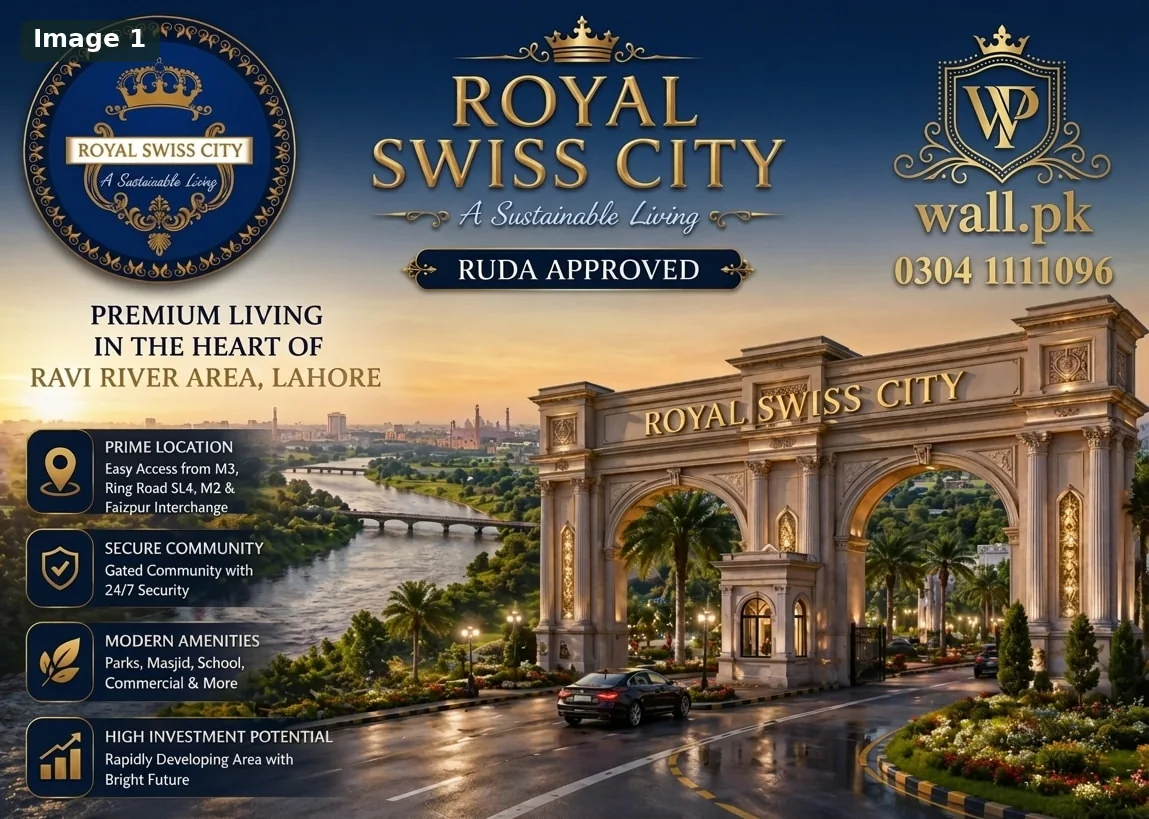
Royal Swiss City Lahore is a RUDA-approved residential development in the Sharaqpur corridor, part of the Ravi River Urban Development Zone extending north of the city toward Kala Shah Kaku. The scheme is being developed by HRL (Habib Rafiq Limited), the same construction and infrastructure firm behind Capital Smart City Islamabad, Lahore Smart City, and Heaven 20 Heights (cantonment high-rise alternative), partnered with RKS Developers as the residential community delivery partner.
RUDA's own official Housing Schemes Provisional Planning Permission (PPP) list confirms the scheme at 800 Kanal, with PPP Granted status and soft launching allowed. We've verified this directly against RUDA's published records rather than relying on developer marketing claims (see the RUDA approval section below). A published payment plan graphic also confirms pricing for 3.5 Marla and 5 Marla plots on a 4-year instalment structure, which we've laid out in full below. Broader master plan detail, including the full Marla-tier catalogue, block names, and total plot count, is still not publicly disclosed. This page documents what we can verify from primary sources, names what we can't, and provides a verification checklist for buyers committing capital before fuller documentation is published.
Quick answers
- Authority
- RUDA PPP Granted (verified on RUDA's official list) · soft launching allowed
- Developer
- HRL (Habib Rafiq Limited) + RKS Developers
- Location
- Sharaqpur corridor, Ravi River Development Zone
- Area
- 800 Kanal, per RUDA's official PPP list
- Access
- Lahore Ring Road (SL4) · M-2 Motorway · M-3 Motorway · Lahore-Sharaqpur Road · Faizpur Interchange
- Plot types
- 3.5 Marla and 5 Marla published; other sizes may exist but aren't shown in current material
- Payment structure
- 4-year plan: down payment, then 45-day confirmation, then allocation charge, then 48 monthly instalments
- Overseas-friendly
- NICOP and passport documentation accepted for remote booking
Location, access and the Ravi River corridor
Royal Swiss City sits in the Sharaqpur corridor of the Ravi River Urban Development Zone, Lahore's most actively planned new growth corridor, north of central Lahore in the catchment extending toward Kala Shah Kaku and the M-2 Motorway interchange. This is the same broad zone that RUDA was specifically established to plan and regulate, and RUDA's own PPP list confirms the scheme's area at 800 Kanal.
Five access routes
| Route | Role |
|---|---|
| Lahore Ring Road (SL4) | Primary arterial connecting northern and western Lahore zones, the structural backbone for intra-city commute |
| M-2 Motorway | Lahore-Islamabad motorway, inter-city connectivity for overseas and northern-Pakistan buyer demand |
| M-3 Motorway | Lahore-Abdul Hakim motorway, opens connectivity south toward Faisalabad and Multan |
| Lahore-Sharaqpur Road | Established surface link to the western Lahore housing belt and beyond |
| Faizpur Interchange | Critical interchange node tying multiple corridors together |
The location story for Royal Swiss City rests on its position within RUDA's broader plan rather than on any single landmark proximity. As the Ravi corridor matures, with infrastructure delivery, commercial anchors, and the cluster of other RUDA and adjacent schemes filling in, the area's accessibility profile will improve. The early-entry thesis depends on this corridor evolution playing out over a multi-year horizon.
Surrounding scheme cluster
The neighbourhood already carries an active development cluster, a useful signal that capital has been flowing into the corridor for some time. Schemes in the broader area include Lahore Garden, Al Rehman Garden Phase 2, Adams Housing Lahore, Shadman Enclave, Lahore Future City, New Metro City Lahore, and the established New City Paradise, Park View City Lahore, and Lahore Modern City. The clustering is its own evidence: developers don't position adjacent to confirmed-empty land.
Google Maps location
📍 See the embedded map above for the exact site location. Open in Google Maps →
RUDA approval: what it means and how we verified it
RUDA, the Ravi Urban Development Authority, is the regulatory body established by Punjab to plan and govern development in the Ravi River Urban Zone. Royal Swiss City Lahore holds RUDA approval, which is the foundational legal credential for any scheme operating in this corridor.
We checked this directly against RUDA's own official Housing Schemes Provisional Planning Permission (PPP) list rather than relying on the developer's own claim. Royal Swiss appears as entry 14 on RUDA's published register, at Lahore Jaranwala Road, Mouza Tariddewala, Tehsil Sharaqpur, District Sheikhupura, with an area of 800 Kanal, status PPP Granted, and the remark "Soft launching is allowed." The screenshot below is cropped from that official government list, with the other 13 schemes on the same page blurred out and the Royal Swiss row highlighted, so you can see exactly where it sits on RUDA's own record without us just asserting the claim.
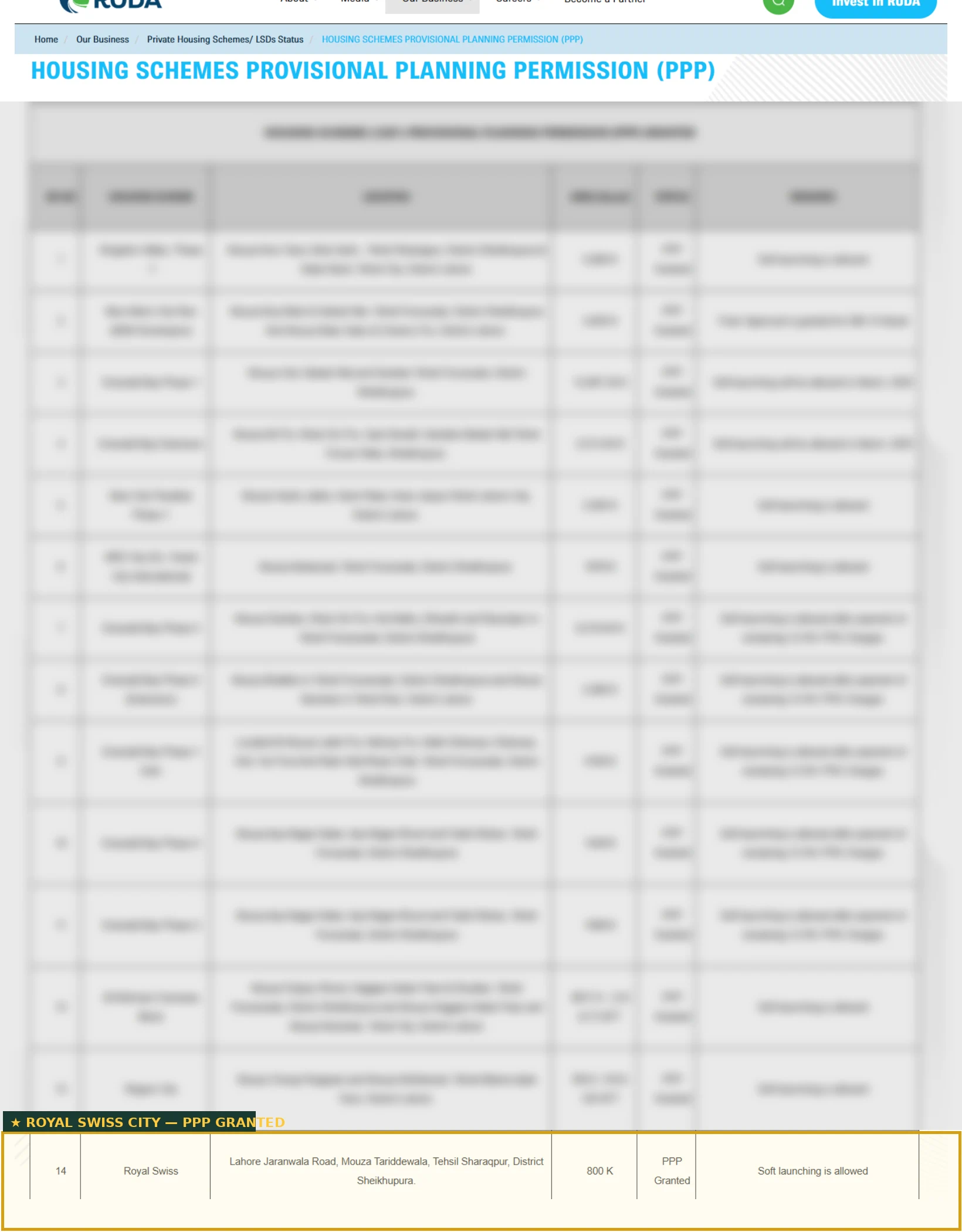
PPP Granted means RUDA has cleared the scheme's provisional planning at the stage documented, and the "soft launching is allowed" remark is RUDA's own language, not the developer's. It's a meaningfully different status from RUDA's later-stage approvals, Technical Approval and Final Sanction, which the same official list tracks separately. A PPP Grant lets a developer begin marketing and soft-launching a scheme; it isn't the same as full and final sanction. Ask the developer directly which of RUDA's approval stages the scheme has actually reached as of today, since this list can move forward over time and this page reflects what was published as of our August 2026 check.
Beyond the PPP list, verifying the NOC document directly with the developer is still the single most important pre-payment step. Cross-checking the scheme name against RUDA's published list, as we've done above, is a necessary first layer, not a substitute for obtaining your own copy of the project's NOC before paying anything.
The developers: HRL and RKS
Habib Rafiq Limited (HRL)
HRL is one of Pakistan's most established construction and infrastructure firms, with a 60+ year operating history. The company has delivered foundational national infrastructure including the M-1 Lahore-Islamabad section, Multan Airport, and major civil works across roads, oil and gas, and aviation. In real estate, HRL is the institutional partner behind Capital Smart City Islamabad and Lahore Smart City, Pakistan's two flagship smart-city developments, and also delivers Royal Swiss Housing Multan (a separate MDA-approved scheme on Bahawalpur Bypass).
This track record is the strongest single credential behind Royal Swiss City Lahore. HRL's involvement signals institutional-grade financial backing, construction expertise, and a delivery record on large-scale master-planned communities that few Pakistani developers can match.
RKS Developers
RKS Developers is the residential community development partner for Royal Swiss City Lahore. Public information on RKS, including SECP corporate registration details, director list, and prior delivered projects, is less extensive than for HRL's institutional footprint. Buyers should treat this asymmetry as a verification opportunity rather than a deal-breaker: request the RKS SECP record, ask for a list of any prior projects, and visit them if possible before committing significant capital. The RKS-HRL partnership pattern is structurally similar to HRL's FDH partnership at Capital Smart City, where one party brings infrastructure capability and the other brings residential community delivery experience.
Master plan: what's confirmed and what isn't
The published master plan describes Royal Swiss City Lahore as a residential and commercial community with wide planned roads, organised blocks, green belts, gated security, and built-in utility infrastructure (water, sewerage, electricity). RUDA's own PPP record confirms the scheme covers 800 Kanal at Mouza Tariddewala. Both residential and commercial plots are offered in multiple sizes within a single planned community, designed to support a self-sustaining environment where residents can live, work, and access daily services without external dependency.
What isn't publicly disclosed at this stage: the full Marla-tier catalogue beyond the 3.5 Marla and 5 Marla sizes shown on the developer's own payment plan graphic, specific block or sector names, and the precise plot dimensions per tier. The standard Pakistani sizing convention (5 Marla as 25×45 ft, 10 Marla as 35×70 ft, 1 Kanal as 50×90 ft) will apply, but the exact mix of those tiers depends on the master plan documentation buyers need to request directly.
For buyers, the practical implication: the master plan PDF, current allotment block, and specific plot dimensions should be requested in writing from the developer before any booking commitment. Treat any verbal claims about specific sizes or pricing tiers as preliminary until confirmed in writing on developer letterhead.
Plot categories: residential and commercial
Residential plots in Royal Swiss City are intended for families building homes in a planned community. The developer's own payment plan graphic confirms 3.5 Marla and 5 Marla residential sizes with published pricing; larger tiers may exist but aren't shown in the material we've reviewed. The published descriptions reference wide roads between plot blocks, adjacent green belts and parks, utility provisions built into the grid from the outset (water, electricity, sewerage), and proximity to planned schools and healthcare facilities.
Commercial plots are positioned within the scheme's planned commercial zones, with built-in foot traffic from the residential community itself. Commercial inventory typically suits retail, small offices and business centres, clinics and pharmacies, and rental-income properties. The dual residential-plus-commercial design supports a self-sustaining environment: residents don't need to travel far for daily needs, and commercial buyers benefit from an in-built consumer base.
Standard Pakistani plot dimensions apply across both categories. Confirm the exact dimensions of any allotted plot against the official site plan before signing. Dimensional mismatches between marketing brochure and on-ground demarcation are a documented post-allotment risk that the buyer's diligence layer needs to catch before payment commitment.
Payment plan structure
Royal Swiss City's developer publishes a payment plan graphic confirming pricing for two plot sizes on a 4-year payment plan: a down payment, a confirmation payment due 45 days after booking, an allocation charge, and 48 monthly instalments. The graphic notes these figures cover the cost of land only; development or other charges aren't included in the numbers below.
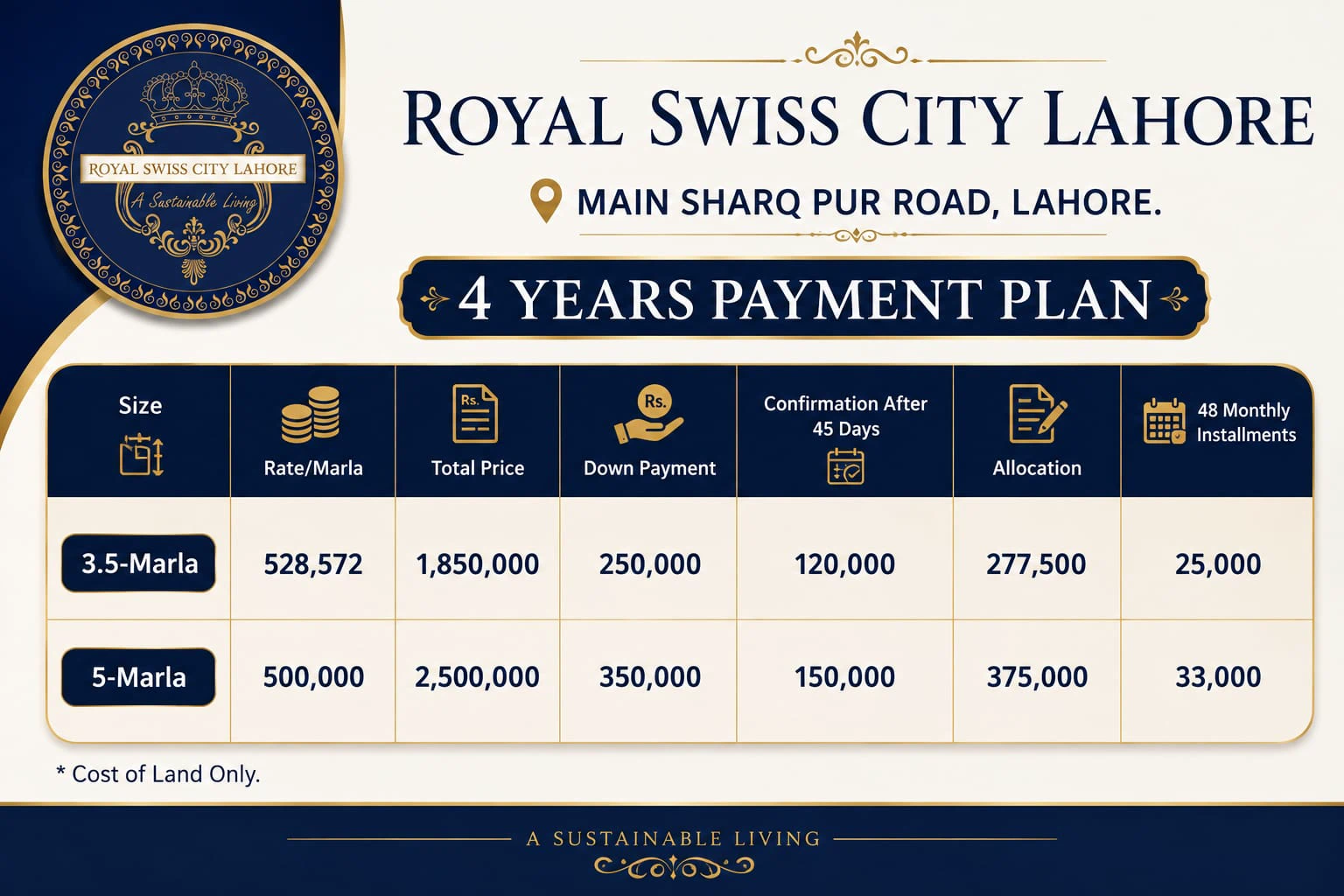
| Size | Rate / Marla | Total Price | Down Payment | Confirmation (45 Days) | Allocation | Monthly (×48) |
|---|---|---|---|---|---|---|
| 3.5 Marla | 528,572 | 1,850,000 | 250,000 | 120,000 | 277,500 | 25,000 |
| 5 Marla | 500,000 | 2,500,000 | 350,000 | 150,000 | 375,000 | 33,000 |
All figures in PKR, cost of land only. Confirm development charges, prime-location surcharges, and any other add-ons directly with the developer. Figures per the developer's own published payment plan graphic and subject to change.
The published structure runs as five payments per plot: a down payment at booking, a confirmation payment due 45 days later, an allocation charge, then 48 equal monthly instalments covering the balance. Both published sizes work out to roughly the same shape: down payment plus confirmation plus allocation covers about a third of the total price, with the remaining two-thirds spread across the 4-year monthly instalment run.
What the published graphic doesn't cover: any plot size beyond 3.5 and 5 Marla, commercial plot pricing, prime-location or corner-plot surcharges, and whether development charges are billed separately or already reflected elsewhere. Development-linked milestone payments and a final balance at possession (a common structure in RUDA-corridor schemes) aren't mentioned on this particular graphic either, so ask directly whether they apply on top of the 48-month schedule shown here. Request the full written schedule on developer letterhead, including late-payment penalty clauses, default consequences, and any pre-possession cancellation policy, before booking.
Amenities and lifestyle
The published master plan describes a full lifestyle ecosystem rather than a bare plot society. Planned amenities include landscaped parks and green belts woven through the layout, planned schools and educational facilities within or near the community, healthcare provisions (clinics, pharmacies, medical centres), mosques and community gathering spaces, planned commercial zones with everyday retail within walking distance, gated security with controlled entry points, and the utility infrastructure foundation of proper sewerage networks, reliable water supply, electricity grid, and well-paved roads.
For buyers, the honest framing is this: amenity descriptions in early-stage scheme documentation reflect the developer's plan, not the on-ground delivery. The verification layer is straightforward: visit the site, see what's actually built, and compare it against the brochure timeline. Each on-ground milestone matched against the published plan adds confidence; each gap or delay flags execution risk. Smart-city and master-planned schemes historically promise more on-ground delivery than standard plot societies, so the milestone verification matters more here, not less.
Overseas Pakistani buyer process
The booking workflow has been structured specifically to support overseas Pakistanis investing remotely. The acceptance of NICOP and passport documentation in place of the standard CNIC requirement, flexible installment arrangements designed for currency-transfer logistics, and the option to designate authorised representatives for site visits and document collection all reduce friction for buyers based abroad.
For overseas buyers, the additional diligence layer is establishing trust at distance: independently verifying the RUDA approval document, confirming HRL and RKS Developers' SECP corporate records through any Pakistani family member or trusted property professional based in Lahore, requesting the full payment schedule and master plan documentation in writing before any wire transfer, and using formal banking channels (pay order in favour of the registered developer entity) rather than informal money transfer arrangements.
How Royal Swiss City compares to peer Lahore schemes
Royal Swiss City Lahore is a RUDA-approved scheme on the Ravi corridor. It is described as backed by an institutional developer with a smart-city track record. The closest peer comparisons in our coverage:
Against New City Paradise Lahore: both are RUDA-approved schemes in the Ravi River corridor, both targeting the early-entry investor segment, and both depend on the corridor's broader development pace for value capture. The decision between them turns on developer track record specifics and on which scheme's master plan and on-ground delivery the buyer can independently verify.
Against Lahore Smart City: the comparison is generational. Both share HRL (Habib Rafiq Limited) as a development anchor, but Lahore Smart City is LDA-approved on Lahore Bypass (Kala Shah Kaku Interchange), master-planned by Surbana Jurong, and has been actively allotting plots for several years. Royal Swiss City is an earlier-stage RUDA-approved entry, with lower entry pricing but earlier in the delivery cycle, and the corresponding earlier-stage execution risk.
Against Capital Valley Lahore: both target the affordable-entry segment but on different corridors and under different regulatory authorities. Capital Valley sits LDA-approved on 14-km Multan Road with a documented 286-plot inventory and published payment plan; Royal Swiss City sits RUDA-approved (PPP Granted) in the Ravi corridor with a published 4-year plan for its two known sizes (3.5 and 5 Marla) but a thinner full-catalogue disclosure and a structurally stronger developer backing. The choice is corridor preference (Ravi vs Multan Road), authority preference (RUDA vs LDA), and developer-credential weighting (HRL+RKS vs Shabraj Developers).
Against Capital Smart City Islamabad: different city, same HRL anchor, similar smart-city positioning. Buyers comparing across cities are typically choosing based on work and family ties rather than between equivalent products.
How to book: step by step
- Identify plot category and budget. Decide residential or commercial, target Marla tier, and the down payment plus monthly installment capacity that fits your income pattern.
- Request the master plan and current price list in writing. Specific Marla-tier pricing, block availability, and surcharge schedules should be obtained on developer letterhead before plot selection.
- Visit the project site. Always see actual on-ground status before any booking: boundary status, road preparation, infrastructure milestones in your target sector.
- Verify the RUDA approval document. Request a copy from the developer and cross-check the scheme name against the official RUDA published-projects list at ruda.gov.pk.
- Prepare booking documentation. CNIC copy (NICOP/passport for overseas), passport-size photographs, nominee CNIC copy, completed application form, and the booking amount via pay order or cheque in favour of the developer's registered entity. Never via cash.
- Submit application and pay booking amount. Receive an officially stamped receipt and provisional allotment letter, and keep multiple copies in safe storage.
- Complete confirmation tranche within the documented window. This converts the provisional allotment to confirmed status, the critical document for any future resale.
- Begin the installment cycle. Track payments carefully; late-payment penalty clauses compound over multi-year cycles. Maintain a complete receipt record from booking through to balance payment.
- Possession at completion. Final balance falls due when the sector reaches possession-ready status. Document the allotment letter and transfer paperwork carefully, since this is the basis for all future resale and transfer transactions.
The honest read
What works in Royal Swiss City's favour: RUDA approval is the foundational regulatory credential for any scheme in the Ravi corridor, and having it sets the project apart from a long list of unapproved or NOC-pending alternatives in the broader area. HRL's institutional backing brings a 60+ year construction and infrastructure track record, plus direct experience delivering smart-city scale projects at Capital Smart City Islamabad and Lahore Smart City. The Ravi corridor itself is a major Punjab planning initiative, and buyers entering early, before the corridor reaches infrastructure maturity, position themselves for the appreciation curve that historically accompanies these large-scale planned-zone developments.
What to weigh carefully: This is still an early-stage scheme. Published pricing covers only two plot sizes (3.5 and 5 Marla); the full tier catalogue, total plot count, and block names aren't yet public. RKS Developers' public information layer is thinner than HRL's, so buyers should treat the SECP verification, prior-project verification, and partnership-structure verification as essential rather than optional steps. PPP Granted is RUDA's earlier-stage approval, not the final sanction. The Ravi corridor still requires the planning vision to translate into on-ground infrastructure delivery, and the early-entry thesis depends on this playing out over a multi-year horizon. Pre-possession secondary-market liquidity for new schemes is structurally thinner than for established ones, so buyers should expect a 5–10 year hold window rather than short-term flip economics.
Suitability map: Royal Swiss City suits long-term investors comfortable with early-entry RUDA-approved Lahore inventory, overseas Pakistanis seeking institutional-developer backing without the established-scheme premium pricing, and end-use buyers planning the Ravi corridor as a multi-year hold before construction. It suits less well: buyers needing immediate possession or short-term resale liquidity, those who require a documented price-per-Marla tier catalogue before commitment, and risk-averse buyers who prefer established corridors like DHA, Bahria, or mature LDA-approved societies where execution risk is materially lower.
Before you book: verification checklist
- Request a copy of the RUDA approval document from the developer and verify the issuance date
- Cross-check the scheme name against RUDA's official published-projects list at ruda.gov.pk
- Confirm whether RUDA approval covers the full master plan or specific blocks only
- Verify SECP corporate registration for both HRL (Habib Rafiq Limited) and RKS Developers independently
- Request RKS Developers' list of previously completed projects and visit prior sites if accessible
- Obtain the master plan PDF showing block names, plot counts, acreage, and amenity placement on developer letterhead
- Get the full payment schedule in writing, including booking percentage, confirmation tranche, installment cadence, milestone trigger points, balance payment, and late-payment penalties
- Confirm prime-location surcharges (park-facing, corner, main-road): amount, stackability, and whether they're fixed or negotiable
- Conduct an off-hours site visit (early morning or late evening) to verify current on-ground development status against the brochure timeline
- Confirm the transfer fee schedule and the NDC (no-dues certificate) workflow for any future secondary-market exit
- Pay only via pay order or cheque in favour of the developer's registered entity, never cash transfers
- Keep certified copies of the booking receipt, provisional allotment letter, confirmation letter, and every installment receipt, since these are the basis for all future resale and transfer
Plots for sale: research desk listings
Specific plot inventory for Royal Swiss City Lahore will be added to this page as our research desk verifies current allotment availability, pricing, and block details directly with the developer. The standard practice on Wall.pk: indicative inventory is published only after we've cross-referenced it against developer documentation, and all pricing is confirmed via WhatsApp before any buyer commitment.
For current Royal Swiss City inventory inquiries, real-time pricing, and allotment availability, message the Wall.pk research desk on WhatsApp at +971 52 804 3509. We confirm RUDA approval status, current developer pricing, and plot block availability before any commitment.
Frequently asked questions
Is Royal Swiss City Lahore RUDA approved?
Yes. Royal Swiss City holds RUDA Provisional Planning Permission (PPP), confirmed on RUDA's own official Housing Schemes PPP list (entry 14: Lahore Jaranwala Road, Mouza Tariddewala, Tehsil Sharaqpur, District Sheikhupura, 800 Kanal), which also states soft launching is allowed. See the screenshot and full explanation in the RUDA approval section above. Buyers should still request a copy of the project's NOC document from the developer before any payment commitment.
Who are the developers of Royal Swiss City Lahore?
The project is developed by HRL (Habib Rafiq Limited) and RKS Developers. HRL is one of Pakistan's most established construction and infrastructure firms with a 60+ year track record, the same group behind the M-1 Motorway, Multan Airport, Capital Smart City Islamabad, Lahore Smart City, and Royal Swiss Housing Multan. RKS Developers is the residential community delivery partner; buyers should verify RKS's SECP registration and prior delivery record independently.
Where exactly is Royal Swiss City Lahore located?
In the Sharaqpur corridor of the Ravi River Development Zone, north of central Lahore. Access routes include Lahore Ring Road (SL4), M-2 Motorway, M-3 Motorway, Lahore-Sharaqpur Road, and Faizpur Interchange. See the embedded map above for the exact site location.
What is the Royal Swiss City Lahore payment plan?
A 4-year payment plan with published pricing for two sizes. 3.5 Marla: PKR 528,572/Marla, PKR 1,850,000 total, with PKR 250,000 down payment, PKR 120,000 confirmation payment after 45 days, PKR 277,500 allocation charge, 48 monthly instalments of PKR 25,000. 5 Marla: PKR 500,000/Marla, PKR 2,500,000 total, with PKR 350,000 down payment, PKR 150,000 confirmation payment after 45 days, PKR 375,000 allocation charge, 48 monthly instalments of PKR 33,000. These cover cost of land only; confirm development charges and any surcharges directly with the developer before booking.
Can overseas Pakistanis book a plot in Royal Swiss City Lahore?
Yes. The booking process accepts NICOP and passport documentation for overseas buyers, with flexible installment arrangements designed for remote investors managing currency-transfer logistics. Use formal banking channels (pay order in favour of the registered developer entity) rather than informal money-transfer arrangements.
What plot sizes are available?
The developer's own payment plan graphic confirms 3.5 Marla and 5 Marla residential plots with published pricing. A wider Marla-tier catalogue or total plot count hasn't been publicly disclosed beyond these two sizes, so buyers should request the official master plan and current allotment availability directly from the developer or authorized sales agent. Standard Pakistani plot dimensions will apply (5 Marla typically 25×45 ft) but the specific mix per tier requires direct confirmation.
How does Royal Swiss City Lahore relate to Royal Swiss Housing Multan?
Both projects involve HRL (Habib Rafiq Limited) but they are separate schemes in different cities under different regulatory authorities. Royal Swiss City Lahore is RUDA-approved (Lahore, Ravi River zone) and partnered with RKS Developers. Royal Swiss Housing Multan is MDA-approved (Multan, Bahawalpur Bypass) and a solo HRL project of approximately 700 Kanal. Despite the similar names, treat them as distinct investments with separate approval frameworks, separate ground status, and separate buyer-side diligence requirements.
How does Royal Swiss City compare to Lahore Smart City?
Both projects share HRL (Habib Rafiq Limited) as a development partner, but the two are at very different maturity stages. Lahore Smart City is LDA-approved, master-planned by Surbana Jurong, sits on Lahore Bypass near Kala Shah Kaku Interchange, and has been actively allotting plots for several years across Executive, Overseas, and other blocks with published pricing. Royal Swiss City Lahore is a newer RUDA-approved (PPP Granted) scheme in the Ravi River corridor, with an earlier entry pricing window, a published 4-year plan for its two known sizes, a thinner full-catalogue disclosure than LSC, and the corresponding earlier-stage execution risk. The choice between them turns on whether the buyer prefers the documented-and-mature smart-city positioning (LSC) or the earlier-entry RUDA corridor thesis (Royal Swiss City).
What's the relationship between RUDA and LDA?
LDA (Lahore Development Authority) is the primary regulatory authority for Lahore's established housing corridors. RUDA (Ravi Urban Development Authority) was established specifically to plan and regulate the Ravi River Urban Zone, a defined geographic corridor extending north from central Lahore. Schemes in the Ravi zone fall under RUDA's jurisdiction; schemes in the established Lahore corridors typically fall under LDA. RUDA-approval and LDA-approval are both legitimate regulatory credentials, and buyers compare them on the basis of corridor preference and the specific regulatory framework rather than treating one as inherently superior.
When can I expect possession?
Possession is linked to development progress in each sector and is finalised once all installments for a plot are complete and the sector reaches possession-ready status. Specific possession timelines are not publicly disclosed in current marketing material. They should be requested in writing on developer letterhead before any booking, ideally with documented milestone commitments tied to the payment plan structure.