

Green Land Housing Scheme Lahore is a recent development of Al Hussain Developers which is a well respected name in the Pakistani constructor industry and boasts a projects a lifestyle infused with ease, natural beauty, and proximity to all the essentials Lahore has to offer.
This housing scheme is located in the of Main G.T. Road, Opposite to Police Training Center and the Quaid-e-Azam Interchange and allows seamless travelling to the major areas of Lahore such as Ring Road, DHA and Allama Iqbal International Airport which is reached in 15 minutes.
Quick reach, makes this scheme attractive and to smart investors of the lost circle of the maket.
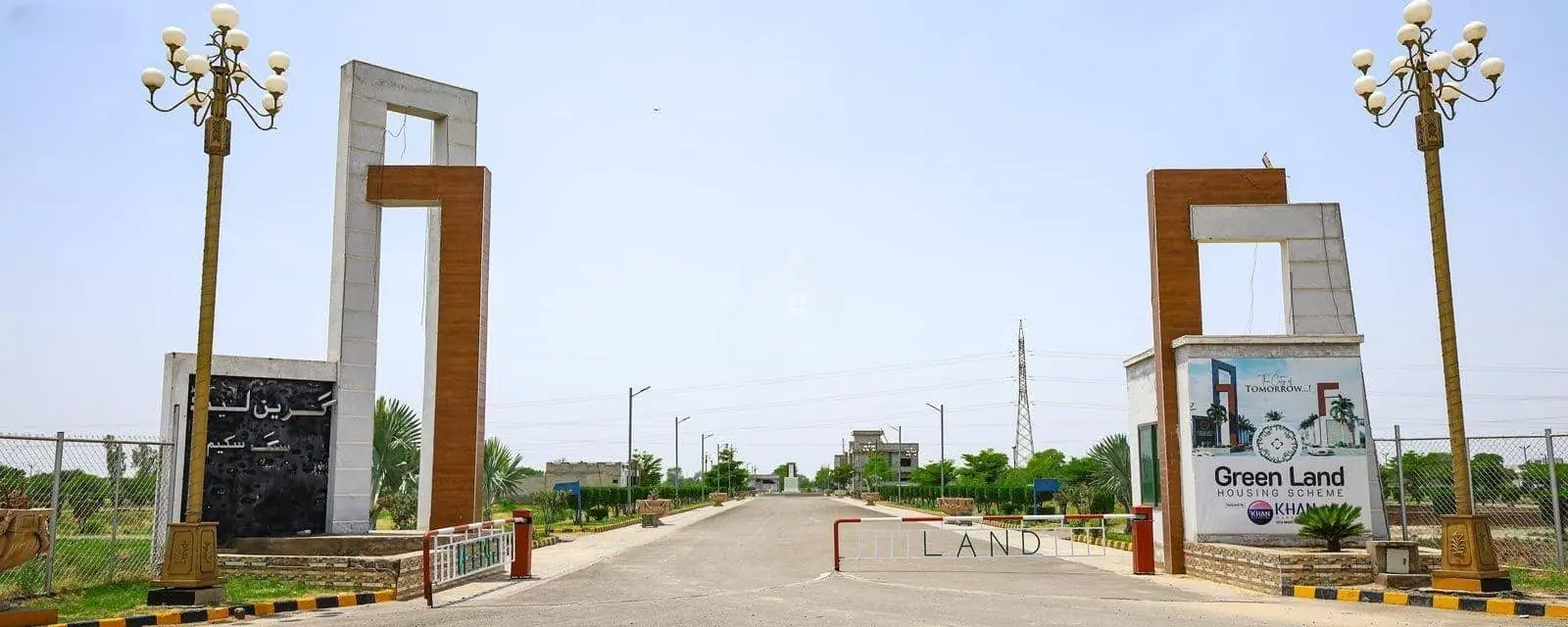
This housing scheme is designed to and a good facilitate a specious, tranquil, and green surrounding with modern amenities for a comfortable lifestyle. For all the families and future business owners, this scheme provides with everything for home and to commercial land and all the extra amenities such as Parks, Mosques, a business zone, and a underground eletricity.
The project provides different plot sizes to accommodate different requirements.
We offer residential plots of different sizes namely:.
If you are looking to invest, we offer commercial plots as well which come in:.
You can book by paying 25% of the total and the rest can be paid in 6 month installments as wanted. With the development work going on, the time to book has come and we urge you to do so.
More than just a housing project, Green Land Housing Scheme Lahore aims to provide residents with a new vision for life; modern, green, and peaceful. With its modern location, dependable builders, and easy payment method; its no doubt it has become one of the finest residential societies in Lahore.
| Green Land Payment Plan | ||||||
| Size | Rate Per marla | Total Price | Booking 25% | 1st instalment after 2 Months | 2nd instalment after 4 Months | 3rd instalment after 6 Months |
| 3 | 435,000 | 1,305,000 | 326250 | 326250 | 326250 | 326250 |
| 3.5 | 435,000 | 1,522,500 | 380,625 | 380,625 | 380,625 | 380,625 |
| 5 | 435,000 | 2,175,000 | 543,750 | 543,750 | 543,750 | 543,750 |
| 8 | 550,000 | 4,400,000 | 1,100,000 | 1,100,000 | 1,100,000 | 1,100,000 |
| 10 | 550,000 | 5,500,000 | 1,375,000 | 1,375,000 | 1,375,000 | 1,375,000 |
| Commercial Area Payment Plan | ||||||
| 600 sqft | 1,400,000 | 3,735,000 | 933,750 | 933,750 | 933,750 | 933,750 |
| 300 sqft | 1,300,000 | 1,735,000 | 433,750 | 433,750 | 433,750 | 433,750 |
Researching this project?
Our research desk can confirm current status, pricing and availability — no commissions.
WhatsApp the research desk — +971 52 804 3509The local market context
Smaller-city schemes live and die on two factors: a genuine local demand anchor (an employer, a cantonment, a trade corridor) and credible paper with the relevant district authorities.
Where both exist, entry pricing well below the metros can compound quietly for years; where either is missing, low prices are usually fair prices. Benchmark the scheme against its corridor's delivered alternatives, weigh the commute math honestly, and let the authority's record — not the brochure — settle the approval question.
How buying in Green Land Housing Scheme actually works
The mechanics are the same as most Pakistani installment societies, and knowing them in advance keeps you in control. It starts with a token — a small amount that holds a specific plot or file for a few days while you verify it.
Token paid, you complete bayana (earnest money, typically 10–25%) against a written agreement naming the plot, the price, and the settlement deadline. The society or project office then processes the transfer: the seller clears any outstanding dues, both parties appear (or send attested authority letters), the transfer fee is paid, and a fresh allotment or transfer letter is issued in your name.
Treat any pressure to compress these stages — "pay full today, transfer next week" — as a signal to slow down, not speed up. Legitimate sellers in liquid societies lose nothing by following the sequence; only problematic files benefit from skipping it.
What you'll actually pay — beyond the headline
The headline price is rarely the final number in Green Land Housing Scheme or any Pakistani society. Budget for the stack that sits on top: development charges (often levied per Marla, sometimes payable in slabs as works progress), possession charges when you take physical handover, utility connection costs for electricity, gas and water meters, the society's transfer fee on purchase, and the tax layer — advance income tax on the transaction under the FBR's withholding regime (rates differ for filers and non-filers and change with federal budgets) plus provincial stamp duty where applicable.
Ask the office for the current schedule of every charge in writing before bayana, and have the seller's paid-up position confirmed against the same schedule — unpaid development charges silently become the buyer's problem after transfer. A plot that looks 5% cheaper than the market often carries exactly that much in hidden arrears.
Documents to collect before and at transfer
- All payment challans for the file's history.
- CNICs, passport-size photos, and POA documents for any absent party.
- Paid transfer fee challan and completed society transfer forms.
- For built property: approved building plan and completion documentation where the society issues them.
- Title chain: the current allotment/transfer letter plus, ideally, the prior links — gaps in the chain are negotiating leverage at best and red flags at worst.
- Dues position: NDC or a written ledger statement from the office.
Keep originals of everything issued in your name and attested copies of the chain behind it — resale later is exactly as smooth as the file you maintain now.
Is this the right fit?
Consider Green Land Housing Scheme if you're buying for use or building a position you can hold: the entry economics and corridor logic favour time in the market.
Skip it if you'd be stretching to the last rupee with no buffer for the charges stack, or if a forced sale within months is plausible — emerging-corridor liquidity punishes forced sellers hardest.
More buyer questions
Is token money refundable if I walk away?
By market custom a token is refundable if the seller's file fails verification, and forfeit if the buyer simply changes their mind — but custom is not enforcement. Put the refund conditions in writing on the token receipt itself: what failure triggers a refund, and by when it must be returned.
Should I buy on installments or pay cash?
Cash purchases in Pakistani societies typically price 15–30% below the equivalent installment total — the developer charges for financing risk. Installments make sense when the entry barrier matters more than the total, or when you'd deploy the retained capital at better returns elsewhere.
Compare the installment premium against what your capital earns; that spread is the real cost of the plan.
How do I check if a society is genuinely approved?
Go to the authority, not the marketing: every development authority maintains records (and increasingly public lists) of approved schemes and phases. Request the current status letter for the specific phase you're buying into — approvals are granted per phase, can carry conditions, and can lapse.
A scheme-level claim in a brochure is the start of the question, not the answer.
How long does a plot transfer usually take?
Once the file is verified and dues are clear, the transfer itself is typically completed in a single office appointment, with the new letter issued the same day or within a few working days depending on the society's process.
The real timeline driver is preparation: dues clearance, document attestation, and — for overseas parties — power-of-attorney processing through the consulate.
Can overseas Pakistanis buy here remotely?
Yes — the standard route is a special power of attorney attested by the Pakistani mission in your country of residence, authorising a trusted local representative to complete verification and transfer formalities. Confirm the society office's specific POA wording requirements before drafting, and route all payments through banking channels in your own name for a clean money trail.
What's the difference between a file and a possession plot?
A file is a right to a plot — often before development or balloting assigns a physical location — while a possession plot is demarcated ground you can fence and build on.
Files trade cheaper and move faster, but carry development-timeline risk and ongoing installment obligations; possession plots cost more and carry less uncertainty. Price the difference consciously rather than treating the two as the same asset.
Buyer takeaways
- Treat launch-stage pricing as an anchor, not a guarantee — confirm live rates before committing.
- Ask which authority approved the project and request the current letter for the phase being sold.
- Compare against two established societies in the same corridor before deciding.
More property news
Buyer due diligence framework
Investment thesis and outlook. The investment case for Green Land Housing Scheme rests on three pillars: capital appreciation tied to corridor development pace, rental yield benchmarks once construction reaches maturity, and resale liquidity in the secondary market — typically 3–5 years out for new schemes. Location anchors like nearby motorway interchanges, ring road frontage, or main boulevard access amplify the appreciation curve. ROI horizon discipline matters more than entry price for buyers planning a hold strategy.
Legal framework and approval status. Green Land Housing Scheme operates under the Lahore Development Authority (LDA). The single most important pre-payment verification is obtaining a copy of the No Objection Certificate from the developer and cross-checking the scheme name against the authority's published approved-list. Older NOCs may have lapsed or been amended — issuance dates matter. Also confirm SECP corporate registration of the developer and the transfer-fee schedule. These three documents (NOC, SECP record, transfer schedule) define the transaction's legal posture.
Transaction mechanics. Plot categories follow standard Pakistani sizing — 3 Marla (~800 sq ft), 5 Marla (~1,125 sq ft), 10 Marla (~2,250 sq ft), 1 Kanal (~4,500 sq ft). The payment cycle moves through booking (typically 10–25% down), confirmation tranche within 30 days, scheduled installments (monthly or quarterly), balloting at allotment, and a balance payment on possession. Required documents: CNIC copy, next-of-kin CNIC, two passport photos, and the booking amount paid through pay order or cheque to the developer's registered entity. Cash transfers are not acceptable for any tranche.