
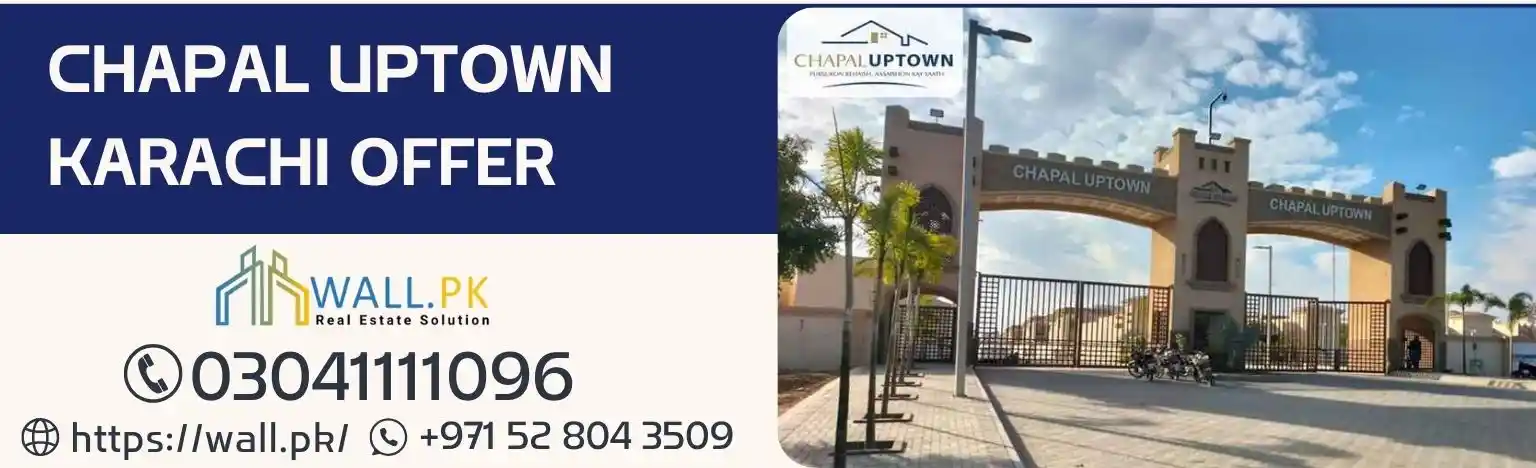
Chapal Group is one of the most trusted developers in Pakistan’s real estate market. That is the reason why Chapal Uptown is no ordinary residential project.
Quick answers
The developers say the project draws on Arabian architecture and community living, and aims to combine functionality with affordability.
Situated between Dreamworld Resort and Gulshan-e-Maymar Housing, Chapal Uptown is serene and calm while remaining easily reachable. For residents, the Karachi Northern Bypass is a major roadway for access to all areas of the city making travel to work, school, and recreational activities easily reachable.
The project's materials describe the area as free of air pollution and away from the crowded metropolitan area, while still connected to it.

Chapal Uptown has seven types of residences, each in an Arabian architectural style.
The residential units come in 120, 160, 200 and 240 square yards, in single and double-storeyed configurations. The developer says the interiors are long-lasting and contemporary.
Chapal Uptown Karachi offers all the essential elements for living, with features for one’s ease, relaxation, and recreation. Some of the core features include:
The project lists community healthcare, schooling, accommodation and commercial space.
Community sports amenities which include a tennis court, cricket ground, basketball court, gymnasium, snooker club, and squash court.
Community recreation facilities including BBQ spots, food courts, and jogging tracks.
Family oriented, secure and thoughtfully eco-constructed neighborhoods.
Chapal Uptown offers a 3-year installment plan. Buyers can also access additional promotional offers such as a PKR 4 Lakh discount, or a 20% discount for outright purchase. For those seeking a fully owned unit, the bungalow is available for 50% upfront payment.
Chapal Uptown Karachi offers payment plans and Arabian-inspired architecture with modern amenities.
Researching this project?
Our research desk can confirm current status, pricing and availability, no commissions.
WhatsApp the research desk: +971 52 804 3509The Karachi context
In Karachi the same area of land can fall under different authorities. SBCA covers construction, while KDA, MDA or a cooperative registrar covers the land beneath, and the risk differs with each combination.
The deepest demand pool in the city remains organised middle-income housing with functioning utilities and credible security, which is why delivered gated schemes hold value through cycles that flatten speculative corridors.
Benchmark any project against that standard: what is actually delivered, and which authority's record confirms it.
What the transaction looks like in practice
Every transaction in Chapal Uptown Karachi should run on the same rails: token → verification → bayana → transfer. The token holds the plot; the verification at the society office confirms the file is genuine, the dues ledger is clear and no hold exists; the bayana agreement locks price and timeline in writing with earnest money; and the transfer appointment closes it: dues challans paid, transfer fee deposited, identities verified, and the letter issued in your name before you hand over the balance.
Overseas buyers add one layer: a special power of attorney, attested by the Pakistani consulate, naming a trusted local representative for the office appearances. Have it drafted around the specific society's transfer requirements, offices differ on wording, and confirm by phone what documents the transfer branch wants before the appointment is booked.
What you'll actually pay: beyond the headline
For Chapal Uptown Karachi, the final cheque stack typically includes the plot price, development charges (verify billed-versus-paid for the specific file), possession charges if you're taking handover, the society's transfer fee, utility connections, and the tax layer at transfer: federal advance tax under the withholding regime plus any provincial duty. None of these are exotic; all of them are routinely forgotten in first-time budgets.
Ask the office for the current schedule of every charge in writing before bayana, and have the seller's paid-up position confirmed against the same schedule: unpaid development charges silently become the buyer's problem after transfer. A plot that looks 5% cheaper than the market often carries exactly that much in hidden arrears.
The paper trail that protects you
- Allotment / transfer letter: the society's core title document, in the seller's name, matching the plot number and size exactly.
- CNIC copies of both parties (and NICOP plus attested power of attorney for overseas parties).
- Seller's allotment or transfer letter. Verify it against the society's own register, and do not rely on how it looks.
- Identity set: CNICs, photographs per office requirement, NICOP and consulate-attested POA where a party is overseas.
- Original allotment/transfer letter and its verification in the society's record room.
- CNICs, passport-size photos, and POA documents for any absent party.
A complete file is also a pricing asset: clean-paper plots consistently sell faster and closer to ask than identical plots with gaps in the chain.
Is this the right fit?
Consider Chapal Uptown Karachi if you're buying for use or building a position you can hold: the entry economics and corridor logic favour time in the market.
Skip it if you'd be stretching to the last rupee with no buffer for the charges stack, or if a forced sale within months is plausible. Emerging-corridor liquidity punishes forced sellers hardest.
More buyer questions
Can overseas Pakistanis buy here remotely?
Yes, the standard route is a special power of attorney attested by the Pakistani mission in your country of residence, authorising a trusted local representative to complete verification and transfer formalities. Confirm the society office's specific POA wording requirements before drafting, and route all payments through banking channels in your own name for a clean money trail.
What's the difference between a file and a possession plot?
A file is a right to a plot, often before development or balloting assigns a physical location, while a possession plot is demarcated ground you can fence and build on.
Files trade cheaper and move faster, but carry development-timeline risk and ongoing installment obligations; possession plots cost more and carry less uncertainty. Price the difference consciously rather than treating the two as the same asset.
Is token money refundable if I walk away?
By market custom a token is refundable if the seller's file fails verification, and forfeit if the buyer simply changes their mind, but custom is not enforcement. Put the refund conditions in writing on the token receipt itself: what failure triggers a refund, and by when it must be returned.
How long does a plot transfer usually take?
Once the file is verified and dues are clear, the transfer itself is typically completed in a single office appointment, with the new letter issued the same day or within a few working days depending on the society's process.
The real timeline driver is preparation: dues clearance, document attestation, and, for overseas parties, power-of-attorney processing through the consulate.
Should I buy on installments or pay cash?
Cash purchases in Pakistani societies typically price 15–30% below the equivalent installment total: the developer charges for financing risk. Installments make sense when the entry barrier matters more than the total, or when you'd deploy the retained capital at better returns elsewhere.
Compare the installment premium against what your capital earns; that spread is the real cost of the plan.
How do I check if a society is genuinely approved?
Go to the authority, not the marketing: every development authority maintains records (and increasingly public lists) of approved schemes and phases. Request the current status letter for the specific phase you're buying into. Approvals are granted per phase, can carry conditions, and can lapse.
A scheme-level claim in a brochure is the start of the question, not the answer.
Buyer takeaways
- Treat launch-stage pricing as an anchor, not a guarantee. Confirm live rates before committing.
- Ask which authority approved the project and request the current letter for the phase being sold.
- Compare against two established societies in the same corridor before deciding.
More property news
- Saima Green Valley Karachi
- Bisma Greens Apartments Karachi
- Falaknaz Dreams Malir Karachi
- Grey Noor Towers Karachi
What to verify before booking
Legal verification checklist. The buyer-side checklist for Chapal Uptown Karachi begins with the No Objection Certificate. Obtain the NOC document from the developer, confirm its issuance date, and cross-reference the scheme name with the Sindh Building Control Authority (SBCA)'s published approved-societies record. SECP corporate registration of the developer entity is a second verification layer that matters for transaction enforceability and dispute resolution. Treat any reluctance to share these documents as a material red flag.
Plot allotment specifics. Plot categories run in Karachi’s standard sq-yd sizing, 120 sq yd (~1,080 sq ft), 160 sq yd (~1,440 sq ft), 200 sq yd (~1,800 sq ft), and 240 sq yd (~2,160 sq ft), verify the exact dimensions of any allotted unit against the latest official site plan, not an outdated brochure. Booking requires CNIC copy, next-of-kin CNIC, two passport-sized photos, and the booking amount via pay order or cheque in favour of the registered developer entity. Cash transfers are not acceptable: they leave no audit trail and complicate later transfer. Keep originals and certified copies of the allotment letter from day one.
Payment cycle and resale outlook. The payment cycle splits across booking (10–25% down), confirmation tranche within 30 days, monthly or quarterly installments, balloting at plot allotment, and a balance payment on possession. Review the late-payment penalty clauses carefully: they compound over multi-year cycles. Resale liquidity for Chapal Uptown Karachi depends on corridor maturation, ROI horizon (typically 3–5 years for new schemes), and rental yield benchmarks once construction is complete. Track the transfer fee and NDC (no-dues certificate) workflow with the developer for any secondary-market exit.